“`html
Norway Stuns Five-Time Champions Brazil in Historic 2026 World Cup Upset

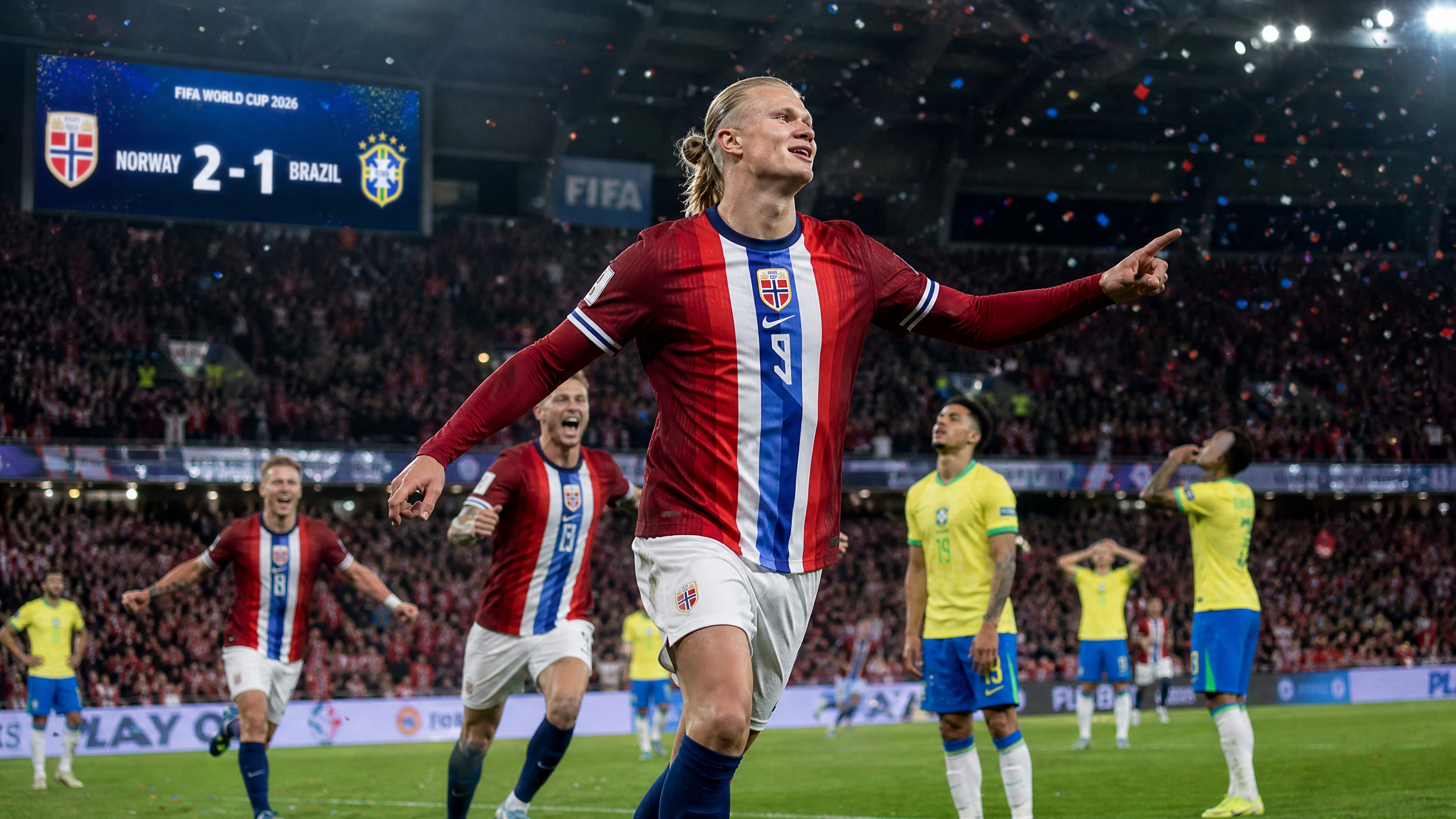
In one of the most electrifying moments in recent FIFA World Cup history, Norway delivered a stunning 3-1 victory over Brazil in the Round of 16 at the 2026 tournament, sending shockwaves through the global football community. Led by the extraordinary Erling Haaland, the Scandinavian underdogs dismantled the defending champions and heavy favorites in a match that will be replayed and debated for generations to come. For Norway, a nation that had endured decades of heartbreak and qualification failures, this victory represented far more than three points—it symbolized a watershed moment for a football program that had long struggled to compete on the world’s biggest stage.
The match, played in a packed stadium with an electric atmosphere, showcased everything that makes the World Cup magical: David versus Goliath, redemption narratives, and the unpredictable beauty of football at its highest level. Brazil arrived as overwhelming favorites, boasting their fifth World Cup title and a squad brimming with superstars and proven pedigree. Yet on this unforgettable evening, Norway proved that form and history mean nothing when execution and determination collide with destiny.
Haaland’s World Cup Redemption: From Years of Heartbreak to Glory
For Erling Haaland, the victory was nothing short of redemption personified. The Manchester City and Norway superstar had spent years watching World Cup tournaments from his living room, forced to witness his peers compete on the grandest stage while he remained trapped in the cruel cycle of Norwegian football’s qualification failures. With Norway perpetually unable to reach the World Cup, Haaland had become the poster child for one of football’s cruelest injustices: a generational talent unable to showcase his abilities on the sport’s most prestigious platform.
That all changed against Brazil. Haaland delivered a masterclass in clinical finishing and physical dominance, scoring twice and creating opportunities that left Brazil’s backline in tatters. His first goal came in the 23rd minute, a perfectly placed finish after latching onto a through ball from captain Sander Berge. The second followed just after the hour mark, a trademark Haaland moment of explosive power and precision that seemed to break Brazil’s collective spirit.
- Two goals from open play, showcasing his lethal finishing ability
- Three key passes, creating dangerous opportunities throughout the match
- Eight successful dribbles, consistently beating defenders in advanced positions
- 60% pass completion in the final third, maintaining attacking efficiency
- Six shots on target, relentless in his pursuit of goal
Beyond the statistics, Haaland’s intangible contributions proved equally valuable. His movement drew multiple defenders, creating space for teammates. His work rate defensively, unusual for a striker of his stature, demonstrated his commitment to the collective cause. Most importantly, his presence energized an entire nation and proved that sometimes individual excellence can elevate a team beyond its perceived limitations.
Brazil’s Collapse: Analyzing the Seleção’s Shocking Breakdown
For Brazil, the 3-1 defeat represented an unthinkable capitulation. The five-time world champions, quarterbacked by their brilliant attacking players and fortified by defensive experience, were simply overwhelmed. The Seleção’s defensive organization, typically a point of pride for the Brazilian program, disintegrated under sustained pressure. Gaps appeared between the lines that Norway exploited with ruthless efficiency. The midfield failed to shield the backline adequately, and the attackers found themselves isolated and unable to create meaningful chances against a well-organized Norwegian defense.
Where Brazil Went Wrong
Several tactical errors contributed to Brazil’s unprecedented downfall. Firstly, head coach Dorival Júnior’s team attempted to play their traditional possession-based game against opponents who were happy to press aggressively and transition quickly. This approach invited pressure rather than controlling the game. Secondly, Brazil’s full-backs, key to their attacking play, were repeatedly caught out of position by Haaland’s intelligent movement and Norway’s counter-attacking runs.
Additionally, Brazil’s attacking players, accustomed to dominating matches, found themselves unsettled by Norway’s physical approach and disciplined defensive shape. The Seleção’s usual creativity seemed suffocated, and moments of individual brilliance failed to materialize. By the time Brazil adjusted their approach, Norway had already secured victory, leaving the Brazilian federation facing uncomfortable questions about preparation, mentality, and whether complacency had crept into their pre-tournament planning.
A Defining Moment: Ranking This Upset Among Football’s Greatest Shocks
To properly contextualize Norway’s stunning victory, we must examine it alongside history’s most memorable World Cup upsets. This defeat ranks alongside the legendary 1950 Uruguay upset of Brazil, the 1954 West German victory over Hungary, and more recently, Spain’s group-stage elimination in 2014. However, this Norwegian triumph carries unique significance: it wasn’t merely a group-stage surprise or a one-off moment, but a complete neutralization of a tournament favorite in knockout football.
Historical Comparisons
- 1950 World Cup: Uruguay’s victory over Brazil in the final match remains the benchmark for World Cup shocks, though it occurred in a different era of global football
- 1954 World Cup: West Germany’s triumph over Hungary in the final showcased how organization could overcome individual brilliance
- 2014 World Cup: Spain’s group-stage failure shocked the football world but never threatened to win the tournament
- 2026 Norway vs. Brazil: A round-of-16 elimination of the tournament favorites, combining historical underdog status with contemporary quality
Norway’s victory proves that upsets aren’t accidents—they’re the result of meticulous preparation, collective belief, and opponents failing to execute their advantages. Unlike some historical surprises where weaker teams simply caught opponents off-guard, Norway systematically dismantled Brazil’s attacking weapons and never allowed the Seleção to find their rhythm.
Norway’s Journey to Glory: Breaking Decades of World Cup Drought
Understanding the magnitude of this victory requires understanding Norway’s painful history. The Scandinavian nation had failed to qualify for the World Cup since 1998—a staggering 28-year drought. During this period, Norwegian football developed a reputation as a respected but perpetually unsuccessful international competitor. Domestic players watched their peers grace the world stage, while they were condemned to watch from television studios or analyst desks.
Norway’s qualification campaign for 2026 represented a gradual building process. Manager Ståle Solbakken implemented a systematic approach, blending the country’s technical traditions with modern athletic standards. The foundation had been laid, but nobody genuinely believed Norway could challenge the established order. This assumption, shared by nearly everyone outside Norway, proved to be the tournament’s greatest misconception.
The Road to History
The qualifying matches preceding the World Cup showed glimpses of promise, but it wasn’t until Norway faced Brazil that the world recognized a team had truly arrived. The Norwegian supporters who packed the stadium understood the historical importance of their presence there. For an entire generation of players, this was the moment that defined careers and justified the sacrifices made in pursuit of World Cup football.
Implications for Scandinavian Football and the Competitive Balance
Beyond Norway’s immediate triumph, this victory sends seismic waves through Scandinavian football. Denmark and Sweden, Norway’s regional rivals, now face enormous pressure to elevate their own programs. The notion that Scandinavian football should be satisfied with competitive participation rather than championship glory has been conclusively shattered. Norway has demonstrated that geographic or historical disadvantages need not determine destiny.
This success also disrupts the established hierarchy of World Cup favorites. Brazil, traditionally among the tournament’s safest bets, now faces a narrative of vulnerability. Other supposed super-powers will watch replays with concern, recognizing that tactical discipline and collective organization can neutralize even the most talented rosters.
The victory provides a blueprint for ambitious national programs worldwide: invest in development infrastructure, cultivate collective identity over individual stardom, and never accept limitations based on historical precedent. Norway’s triumph validates faith in long-term planning and suggests that the 2026 World Cup could be one of the most unpredictable and thrilling tournaments in decades.
The Haaland Factor: Individual Brilliance in Service of Collective Purpose
While Haaland’s performance was exceptional, what elevated this moment beyond individual accomplishment was his willingness to serve the team’s collective objectives. He could have pursued personal glory, attempting highlight-reel moments. Instead, he worked within Norway’s system, maximized his opportunities, and lifted teammates through effort and execution. This balance—elite individual performance channeled toward team success—represents the ideal embodiment of World Cup football.
Haaland’s redemption story adds a compelling narrative layer to Norway’s historic moment. Never again will anyone question his quality or bemoan his World Cup absence. He has announced himself on the grandest stage imaginable, not against lesser opposition, but against one of football’s greatest nations.
Conclusion: A Watershed Moment for Football
Norway’s stunning 3-1 victory over Brazil in the 2026 FIFA World Cup Round of 16 represents one of those rare, crystallizing moments in sports history—a result that reshapes narratives, challenges assumptions, and reminds us why the World Cup remains football’s ultimate stage. For a nation that endured 28 years without World Cup football, for a player like Erling Haaland who seemed destined to miss his entire prime at sport’s highest level, and for all those who believe that belief and preparation can overcome history and expectation, this moment vindicated everything.
As the football world reflects on this shocking elimination of the five-time champions, one certainty emerges: the 2026 World Cup has already delivered one of its defining moments. Norway has announced itself as more than tournament participants—they are genuine contenders, and Scandinavian football has entered a new era. Brazil, meanwhile, will spend years analyzing what went wrong in a match that proved, once again, that in football’s greatest competition, no outcome is predetermined.
This is the World Cup’s magic: the promise that on any given day, through preparation, determination, and excellence, anyone can achieve the previously impossible.
“`
Subscribe to Our Newsletter
Get the latest articles on Tech, Finance & more delivered to your inbox. No spam, ever.
We respect your privacy. Unsubscribe anytime.




About the Author
World Daily Editorial Team
The World Daily Editorial Team covers global news, travel, technology, finance, and health. Our writers research and curate the most relevant stories from around the world to keep you informed and inspired.