“`html
France vs Morocco 2026 FIFA World Cup Quarterfinal: Revenge, Glory, and African Football’s Moment

The stage was set for one of the most compelling rematches in modern football history. Four years after Morocco’s stunning upset victory over France in the 2022 World Cup semifinal, the two nations collided once more in the 2026 quarterfinals with far more than pride on the line. For France, it was about redemption and reclaiming their place among the tournament’s elite. For Morocco, it was an opportunity to silence their critics and cement themselves as a genuine force in world football. What unfolded was a match that transcended sport, capturing the imagination of millions across Europe, Africa, and beyond.
The Prelude: A Rematch Four Years in the Making
Few moments in recent World Cup history had the weight of France’s 2022 semifinal loss to Morocco. That shock defeat sent shockwaves through European football, proving that the traditional powerhouses were no longer invincible. Morocco’s defensive masterclass and clinical finishing had knocked out the defending champions, and now, in 2026, the French national team had the chance to avenge that humiliation on football’s biggest stage.
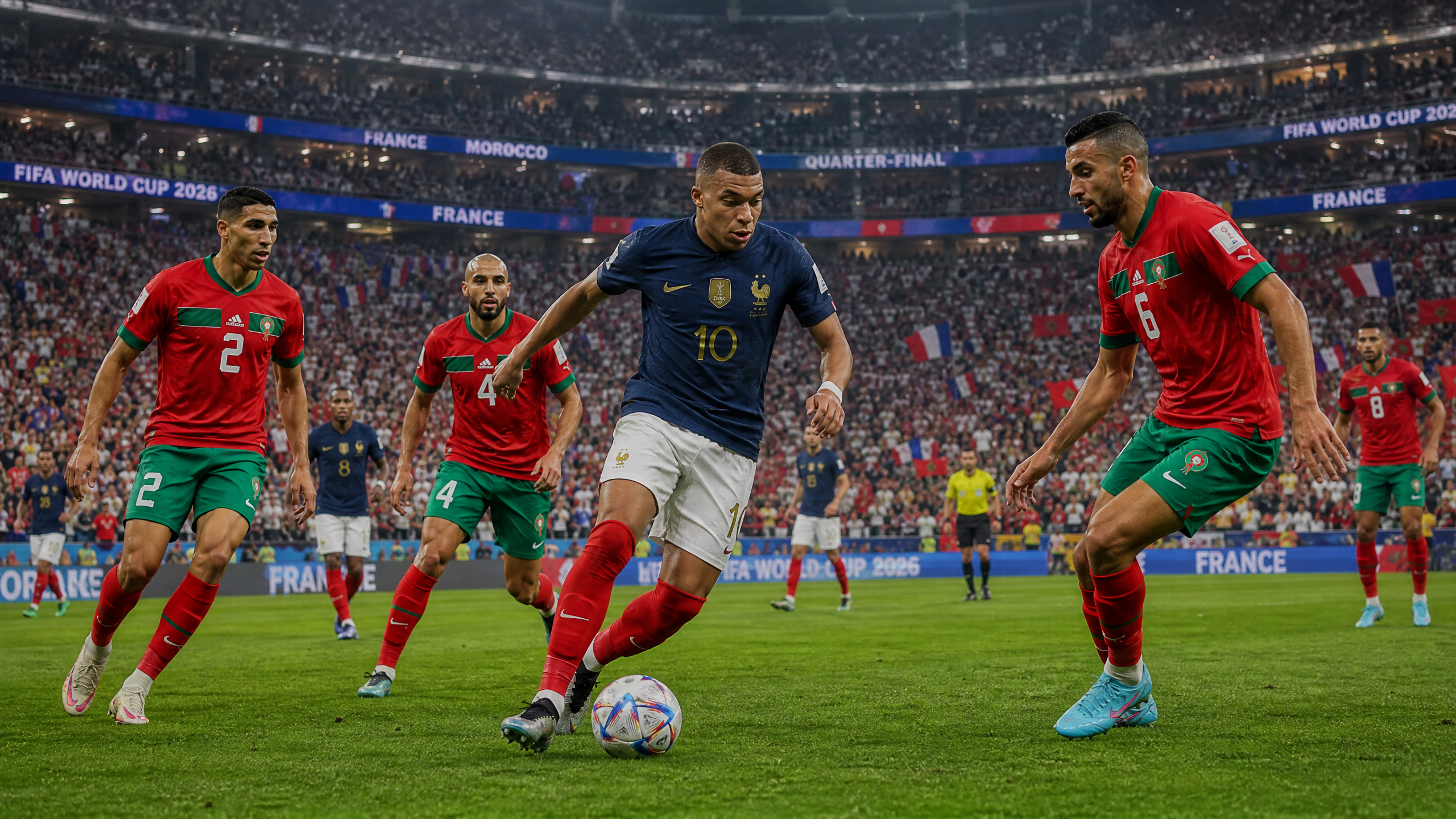
The narrative heading into this quarterfinal was impossible to ignore. Kylian Mbappé, who had been instrumental in France’s 2022 campaign, was visibly motivated to erase the memory of that loss. The young superstar had matured in the intervening years, gaining experience at Real Madrid and cementing his status as one of the world’s elite forwards. This wasn’t just another match for him—it was personal. Mbappé had carried the weight of that previous defeat and now had the platform to prove that France would not be denied twice by the same opponent.
Morocco, meanwhile, had proven that their 2022 run was no fluke. Progressing through a competitive 2026 group stage and knocking out their Round of 16 opponent with characteristic grit and defensive prowess, the North African nation had once again captured the imagination of supporters. They represented something more than just a team seeking success—they were the standard-bearers for African football on the world’s grandest stage.
Key Players and Individual Battles
This match featured several fascinating individual storylines that would ultimately determine the outcome.
Kylian Mbappé vs the Moroccan Defense
Mbappé’s hunger for revenge was palpable in the buildup to the match. At his peak, the French winger possessed the pace, technique, and mental strength to punish any defensive vulnerability. Morocco’s backline, led by experienced defenders who had successfully contained elite attackers before, knew they faced their greatest test. Every run Mbappé made, every burst of acceleration, carried the weight of France’s collective desire for retribution.
Achraf Hakimi’s Defensive Responsibility
The Paris Saint-Germain fullback would be tasked with the impossible job of keeping Mbappé quiet. Hakimi, one of the most dynamic defenders in world football, had the pace and tactical intelligence to potentially shackle the French star, but it would require a flawless performance. One lapse, one moment of inattention, could prove catastrophic against an opponent of Mbappé’s caliber.
Karim Benzema’s Absence and France’s Forward Line
With Benzema retired from international football, France had restructured their attacking philosophy. New faces had emerged, and the midfield-to-attack transition would be crucial. Morocco would need to press intelligently and disrupt France’s rhythm before dangerous passing combinations could develop.
Tactical Analysis: Contrasting Philosophies
This quarterfinal represented a classic clash of football philosophies—attacking flair versus defensive organization.
France: Controlled Aggression
Under their manager, France approached the match with attacking intent. Their gameplan revolved around controlling possession, using their superior technical ability to probe for openings, and exploiting Morocco’s defensive lines through quick transitions. France would look to dominate the midfield battle, using their physicality and technical quality to dictate terms. Wide play would be crucial, with full-backs pushing forward to create numerical advantages and stretching Morocco’s defensive shape.
Morocco: Disciplined Resistance
Morocco’s approach was predictable yet effective. They would sit deep, maintain a compact defensive shape, and look to hit France on the counter-attack. Their strategy involved frustrating their opponents through disciplined positioning, blocking passing lanes, and forcing France into rushed, inefficient play. Set-pieces would be vital—both defensively and offensively, as Morocco couldn’t afford to give France easy opportunities to break them down through open play.
- France targeted width and quick ball circulation
- Morocco focused on defensive blocks and rapid counter-attacks
- Midfield control would be the decisive battleground
- Set-piece execution could prove the differentiator
Match Report: Revenge Served on Football’s Grandest Stage
The opening exchanges showcased the contrasting styles perfectly. France pressed high, seeking to immediately put Morocco under pressure, while the North Africans patiently waited for opportunities to exploit on the break. For the first 20 minutes, neither side could establish clear dominance, though France’s superiority in possession was evident.
The breakthrough came in the 34th minute when Mbappé received the ball on the left wing, just as the narrative had predicted. The French winger’s explosive acceleration left Hakimi momentarily exposed, and after cutting inside, Mbappé unleashed a powerful strike that goalkeeper Bono could only parry. The rebound fell to Antoine Griezmann, who finished clinically to give France a 1-0 lead. The goal carried symbolic weight—France had struck first, and the revenge narrative was beginning to take shape.
Morocco responded with characteristic determination. Their intensity increased, and they began to create half-chances through dangerous counter-attacks. However, France’s improved defending in recent years meant they were less vulnerable to the quick transitions that had undone opponents in previous tournaments.
The second half saw France dominate proceedings further. A second goal arrived in the 58th minute when a sweeping move involving five passes culminated in Mbappé receiving possession in space. This time, the Real Madrid star made no mistake, firing past Bono with a clinical finish. The match was slipping away from Morocco, and despite their best efforts to reorganize and mount a comeback, France’s quality proved too much to overcome.
A late consolation goal for Morocco in the 82nd minute, courtesy of a stunning long-range effort, provided some dignity but ultimately proved mere window dressing. France’s 2-1 victory was comprehensive enough to suggest clear superiority, yet close enough to acknowledge Morocco’s resilience and quality.
Post-Match Reaction and Redemption
In the aftermath, Mbappé was visibly emotional. The revenge that had motivated him throughout the match and in the years preceding it had finally arrived. French supporters celebrated not just a victory, but vindication—proof that their team remained among the world’s elite and could overcome even the most bitter of defeats.
Moroccan players departed with their heads held high. Despite the loss, they had competed with honor against one of football’s traditional superpowers. Their coach emphasized the progress made and the pride their nation should feel in their performances throughout the tournament.
What This Victory Means for Football’s Future
This quarterfinal had ramifications that extended far beyond the immediate tournament. For French football, the victory represented a return to the trajectory expected of a nation with their resources and heritage. It proved their 2022 semifinal exit was an anomaly, not a harbinger of decline.
For African football, Morocco’s tournament run, despite this loss, had been transformative. They had shown that African nations could compete with and challenge the established order. While they hadn’t reached the same heights as 2022, their presence in the quarterfinals remained historic and inspirational for the entire continent.
The match also highlighted the growing importance of diaspora football—the way global communities unite around their nations’ teams transcends traditional geographical boundaries. France’s French-Moroccan and Franco-African communities had made this match as much about cultural identity as sporting achievement.
Looking Ahead: Implications for the Remainder of the Tournament
France’s progression meant they would face either Germany or Spain in the semifinals—another high-stakes encounter with a European giant. Their redemption arc was gathering momentum, and the possibility of reclaiming their status as World Champions seemed increasingly tangible. For Morocco, their 2026 campaign would end with mixed emotions—pride in their achievements tempered by the knowledge that they had come so close to something truly special.
The France vs Morocco quarterfinal will be remembered as a watershed moment in World Cup history. It represented not just the clash of two talented teams, but a symbolic passing of the torch back to the established powers, even as emerging nations continued to stake their claim on football’s future. Mbappé’s revenge was complete, but Morocco’s legacy as torchbearers for African football was only just beginning to be written.
“`
Subscribe to Our Newsletter
Get the latest articles on Tech, Finance & more delivered to your inbox. No spam, ever.
We respect your privacy. Unsubscribe anytime.




About the Author
World Daily Editorial Team
The World Daily Editorial Team covers global news, travel, technology, finance, and health. Our writers research and curate the most relevant stories from around the world to keep you informed and inspired.